- Sellify Success Club
- Posts
- Your Shopify store just got a five-person AI ops team
Your Shopify store just got a five-person AI ops team
for less than the cost of a Netflix subscription

Ada at Sellify
April 13, 2026
In partnership with

Happy Monday, 10,000+ Shopify rockstars!
Ada here, with your weekly dose of ecommerce insights designed to boost your store's sales by at least 1% this week.
Inside today's edition:
Shopify's AI Toolkit just made every AI agent a native Shopify operator
Your spreadsheet bookkeeping is lying to you. Here is how to fix it.
Weekly Challenge: Build a clean profit dashboard in 60 minutes
Trend: Barrel Leg Jeans
Let's get into it.
Shopify just gave AI agents the keys to your store
The bottleneck in ecommerce was never ads. It was operations.
Shopify's AI Toolkit changes that. It is the infrastructure layer that turns AI from something that talks about your store into something that works inside it. AI agents like Claude, Cursor, and Codex now have direct access to your products, orders, inventory, SEO, and images natively. Bulk metafield updates across hundreds of products. Custom reports the Shopify admin will not generate. Product tagging at scale. Store audits. Tasks that used to require a freelancer now run through a terminal.

The setup leans technical, but the outcomes are merchant-relevant regardless of whether you write a line of code. One caveat worth taking seriously: test in dev. Production is not your playground.
Shopify is not building the agent. It is building the protocol that makes every agent a Shopify agent. Four point eight million merchants just got a five-person team for the price of an AI subscription. The stores that figure this out first are going to move faster than you.
Tip: The right way to use AI to improve your store visibility: Use Plug In AI to fix what’s preventing your store from ranking organically
Growth Hack: Your Spreadsheet Is Not a Bookkeeping System
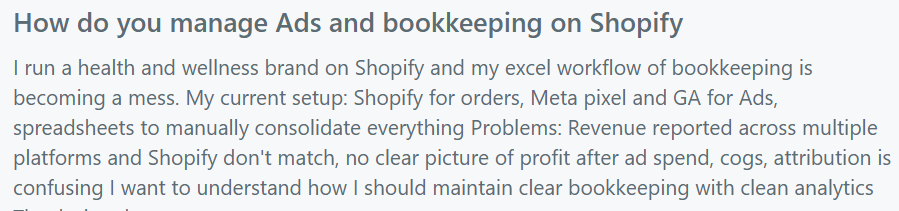
If this is you, stop trying to make one spreadsheet be both your accounting system and your marketing dashboard.
Shopify is your only real revenue number. Meta and Google are attribution models that will never reconcile to the dollar. The fix is two separate layers. Bookkeeping: connect Shopify to a ledger tool that pulls in fees, refunds, COGS, and ad spend consistently every day. Marketing performance: track attribution separately so it never pollutes your financials.
For profit, keep it simple. Total Shopify revenue divided by total ad spend across all channels. That is your MER, marketing efficiency rate, and it is the one number that tells you how efficiently your marketing is working without the noise.
Stop babysitting dashboards. Ship from Slack. Touch grass.

700+ teams have Viktor reading their Google Ads every morning.
Your media team opens Slack at 8am. There's a cross-platform brief in #growth: Google Ads spend vs. ROAS, Meta CPA by campaign, Stripe revenue by channel. Viktor posted it at 6am. Nobody asked for it.
Last week, one team's Viktor caught a spend spike at 2am on a broad match campaign and flagged it in Slack: "CPA up 340%. Recommend pausing and shifting budget to the top two performers." That would have burned $3K by morning. The media buyer woke up to a problem already handled.
Your strategist reviews spend trends. Your account manager checks revenue attribution. Same Slack channel, same colleague, before anyone's first coffee.
Google Ads, Meta, Stripe. One message. No Looker, no Data Studio. Anomaly detection runs around the clock. Cross-platform reporting runs on autopilot.
5,700+ teams. SOC 2 certified. Your data never trains models.
"Viktor is now an integral team member, and after weeks of use we still feel we haven't uncovered the full potential." — Patrick O'Doherty, Director, Yarra Web
Challenge: Build Your Profit Dashboard This Week
Step 1 (20 mins): Search the Shopify App Store for a profit dashboard app. Lifetimely, BeProfit, and Profitario are worth comparing. Connect it and let it pull orders, COGS, and fees automatically.
Step 2 (20 mins): Connect your Meta and Google ad accounts so spend flows into the same view. One dashboard. Revenue, ad spend, COGS, fees together.
Step 3 (20 mins): Calculate your MER for the past 30 days. Write that number down. Every decision about your ad accounts from this point gets measured against it.
Stop reconciling. Start reading one number.
Trend: Barrel Leg Jeans
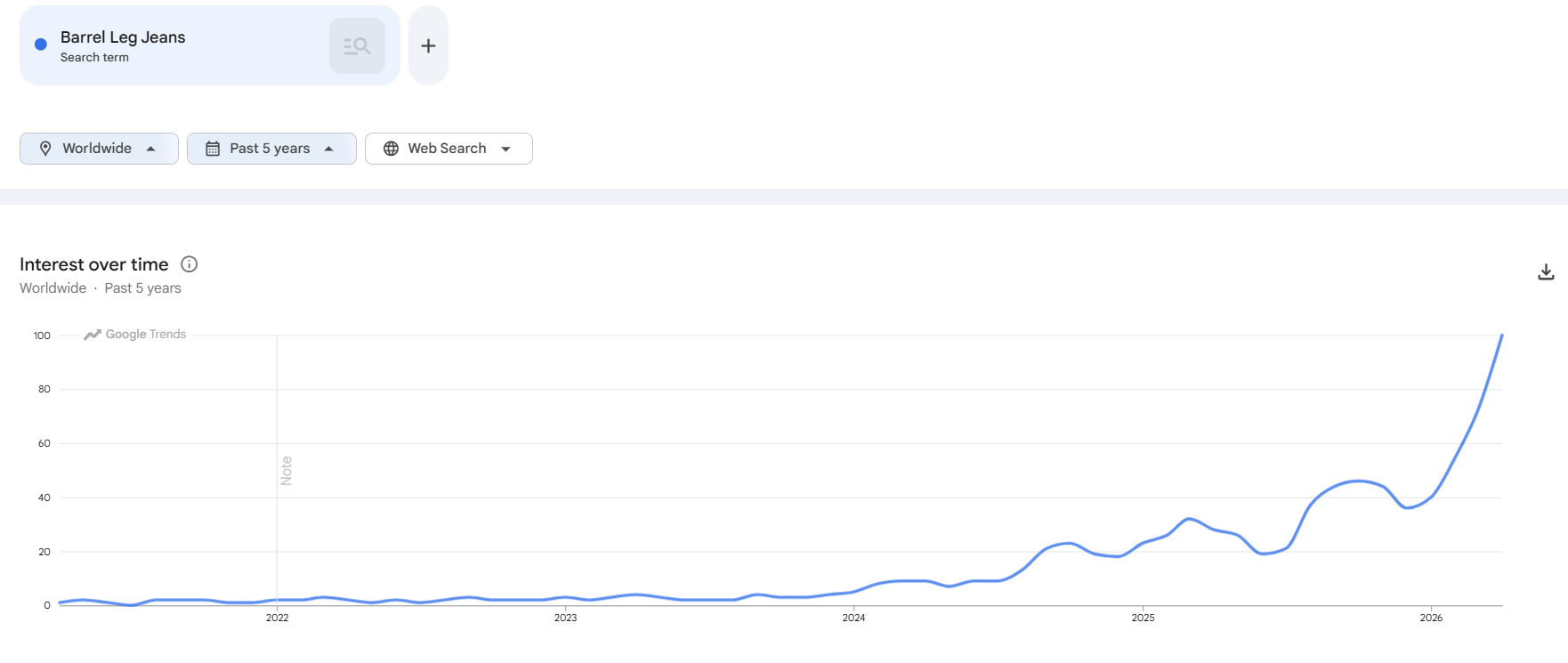
Searches for barrel leg pants have increased by more than 1,000 percent in the last two years. These are the baggy jeans that hit near the belly button, widen at the knee, and taper back at the ankle. They are everywhere on social media because they are tricky to style, which creates a massive opportunity for educational content. From Gigi Hadid to Jennifer Lopez, the "extra roomy" look is dominating the oversized fashion trend.
👉 How you can tap into this trend:
Create "how to style" content: The barrel leg is a silhouette that scares people. Show them how to pair it with fitted tees or heels to balance the volume.
The "Oversized" bundle: Pair these jeans with menswear staples like poplin shirts to lean into the oversized suit trend.
Target the "comfort" buyer: Use creative that highlights the relaxed fit and ease of movement. Customers are currently gravitating toward silhouettes that provide a polished look without the restriction of slim denim.
Till next week,
Ada