- Sellify Success Club
- Posts
- ChatGPT becomes a Shop Campaigns paid ad channel
ChatGPT becomes a Shop Campaigns paid ad channel

Ada at Sellify
March 09, 2026
In partnership with

Happy Monday to 10,000+ unstoppable Shopify savants.
Ada here with your weekly 5 minute briefing designed to help you boost your store’s sales up by at least 1% this week.
Here is what is inside today’s edition:
Industry: ChatGPT becomes a Shop Campaigns paid ad channel.
Growth Hack: Why vendor blogs are the secret weapon for AI visibility.
Weekly Challenge: The 60 minute AI Citation Audit.
Trend: Beef Tallow Face Cream and the simplicity boom.
ChatGPT becomes a Shop Campaigns ad channel
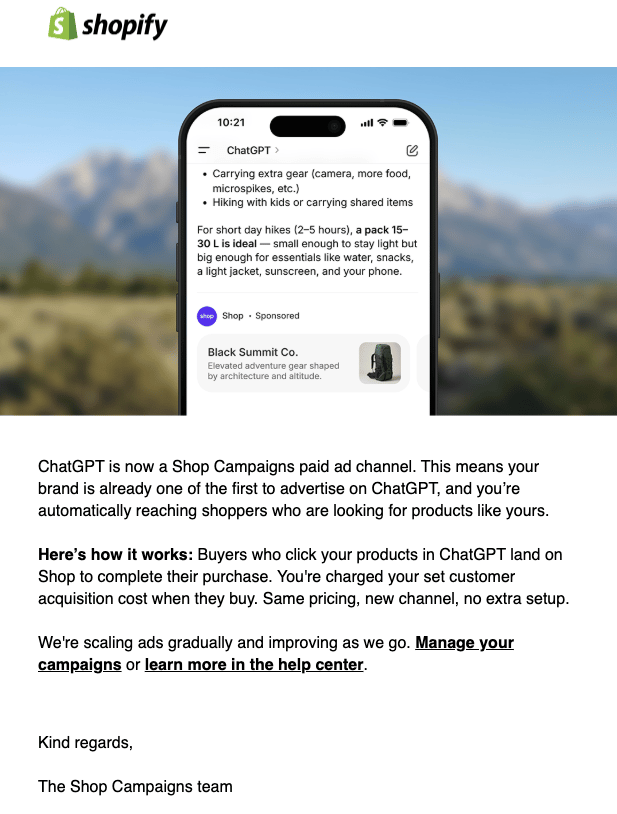
ChatGPT is now a Shop Campaigns paid acquisition channel for Shopify merchants. This means products can appear directly inside ChatGPT when users are searching for recommendations. When a shopper clicks a promoted product, they are taken to the Shop app to complete their purchase.
The pricing model is straightforward. Merchants set a target customer acquisition cost and only pay when a purchase actually happens. For Shopify stores, this creates a new discovery surface. Instead of starting with a Google search, shoppers may now begin with an AI conversation and AdVenture even offers instructions on how to set up retargeting for ChatGPT.
This is a major step toward agentic shopping. AI assistants are quickly becoming product research engines. The brands that appear inside these recommendation flows gain visibility long before customers ever reach a traditional search results page. If your product catalog is clean, structured, and easy for machines to interpret, you are already positioned to benefit from this shift.
P.S: To everyone who requested a free AI visibility audi last week, you should have received a audit results/video walkthrough. If you haven’t received these, please email [email protected]. 3 more spaces left for audits. Request yours here.
Growth hack: Turn your vendor blog into an AI citation engine
One of the easiest ways to gain visibility across Google AI Overviews and AI chat tools right now is something many companies still ignore: their own blog. Vendor blogs have quietly become some of the most cited sources inside ChatGPT, Gemini, and Google AI Overviews.
Search 'New Relic alternatives' on Google right now. The AI Overview frequently cites SigNoz, AppSignal, and Honeycomb, pulled directly from their own blog posts. The same pattern appears when you search "How to choose a pickleball paddle”. The AI overview cites a blog post from PDHSports.
On deeper analysis, it appears that this blog post is the second highest traffic referrer to the store.

Vendor blogs work well because they are structured in ways machines can easily interpret. They contain definitions, comparisons, lists, and FAQs that AI systems can quickly extract. Recency also plays a role. Company blogs update far more frequently than traditional media, making them attractive sources for AI models that prioritize fresh information.
Challenge: The 60 minute AI Citation Audit
This week, you are going to audit your blog to make it AI-readable so you can start appearing in these high-value citations.
Step 1 (20 mins): Identify your top three comparison-style posts like “best tools for X” or “alternatives to Y”. These formats are reused most often in AI answers.
Step 2 (20 mins): Rewrite your headers into question-based headings. Replace generic titles like “Features” with questions customers actually ask such as “What are the best tools for [problem]?”.
88% resolved. 22% stayed loyal. What went wrong?

That's the AI paradox hiding in your CX stack. Tickets close. Customers leave. And most teams don't see it coming because they're measuring the wrong things.
Efficiency metrics look great on paper. Handle time down. Containment rate up. But customer loyalty? That's a different story — and it's one your current dashboards probably aren't telling you.
Gladly's 2026 Customer Expectations Report surveyed thousands of real consumers to find out exactly where AI-powered service breaks trust, and what separates the platforms that drive retention from the ones that quietly erode it.
If you're architecting the CX stack, this is the data you need to build it right. Not just fast. Not just cheap. Built to last.
Step 3 (20 mins): Add a short TLDR section at the top and an FAQ block at the bottom using real customer phrasing.
When AI systems scan your article, they should immediately understand the problem being solved and the tools being compared. One well-structured comparison article can become a long-term citation source across every major AI platform.
Trending Product: Beef Tallow Face Cream

Beef Tallow Face Cream, made from rendered beef fat, is currently viral on TikTok and Instagram as consumers seek synthetic-free alternatives. Search interest in "tallow cream" is up nearly 300% in the past two years.
These creams are rich in vitamins A, E, and K, which help protect the skin barrier and reduce inflammation. One popular tallow cream is generating $1.27M in monthly Amazon revenue. Consumers are choosing these products for their short ingredient lists and perceived purity.
How to benefit from this trend:
The opportunity is not limited to selling the cream itself. Here's how to build around this trend:
Publish educational content on ingredient benefits to attract organic and AI-driven search traffic.
Bundle moisturisers with skincare tools for a higher average order value.
Offer subscription refills to build predictable recurring revenue.
Use short, clear ingredient descriptions… AI models can easily extract and cite them.
Till next Monday,
Ada